
Can Crusher
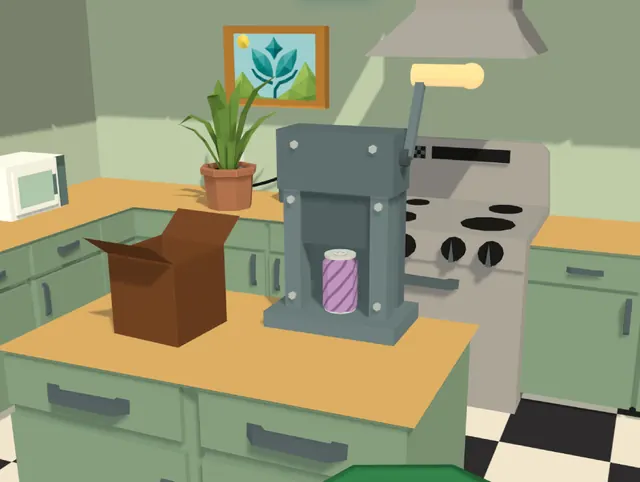
A calming can-crusher: pull the lever to crush a crate of cans into the recycling and clear the pile.
Can Crusher
A calming can-crusher: pull the lever to crush a crate of cans into the recycling and clear the pile.
Type: game
Try 3 exercises for free right now.
Supporting a team?
Zen+ Health helps employers reduce avoidable absence and support wellbeing, privately, with anonymised insight only.
Zen+ Health for Business →What is Can Crusher?
Can Crusher is a short, tactile mini-game for moments when you feel wound up, restless, or full of pent-up energy and sitting still is the last thing you want to do. A can feeds into the machine, you pull the lever down to crush it, it drops into the recycling, and the next one feeds in. Clear the crate and you’re done.
It lives in the games section of Zen+ Health, and that placement is deliberate. Crushing cans is not a grounding exercise - “grounding” is a specific clinical technique for anchoring attention in the senses (like the 5-4-3-2-1 exercise or Finger Anchors), and this isn’t that. What Can Crusher offers is absorbing distraction and a small sense of getting something done: a “doing” task rather than a “sit still and breathe” task, for the times when a breathing exercise feels impossible to start.
The game comes in four artwork packs - Variety, Rainbow, Communications and AI - which change the cans you’re crushing and nothing else. Pick whichever you like the look of.
What makes it different from a fidget game. Plenty of “satisfying” mobile games are built to keep you playing: rising score counters, streaks, no natural end. That pattern is activating - it winds people up rather than settling them. Can Crusher is deliberately built the other way: there is no score, no timer, no fail state and no lifetime tally. There is a crate of cans, and then there isn’t.
How It Works
1. Absorbing distraction, not venting
It is tempting to describe a can-crushing game as “letting off steam”, and it is worth being straight about why we don’t. The idea that expressing anger drains it - catharsis - is one of the most thoroughly tested and least supported ideas in psychology. In a well-known experiment, angered participants who hit a punching bag while thinking about the person who had angered them ended up angrier and more aggressive than those who hit it as a distraction, and doing nothing at all beat venting (Bushman, 2002).
The same study points at what does help: the distraction condition fared markedly better than the rumination one. That is precisely the mode Can Crusher is designed for. The lever, the timing, the crunch and the counter give your attention somewhere concrete to go. It is a task to be absorbed in - not a place to rehearse an argument. If you notice you’re replaying a conversation as you crush, that’s the signal to stop and use a breathing or grounding exercise instead.
2. A finite goal with a natural end
The goal is “clear this crate”, not “beat your record”. Completion-style goals give a sense of control and a clean stopping point; open-ended counters give you a reason never to stop. When the crate is empty the game says so and hands you back to your day. Come back another time and you get a fresh crate - never a running total to protect.
3. Effortful, self-paced motion
The crush is a 1:1 drag: the can compresses exactly as far as you pull the lever, at whatever speed you choose. There is no time limit and no minimum effort. Let go and the arm springs back, but the can never un-flattens - progress only ever moves forward, so you can crush a can in one firm pull or grind through it in a dozen small ones.
The sound follows the same logic. The crunches are recordings of real cans being flattened, and what you hear tracks how far you’ve crushed, not a triggered sound effect. A slow grind genuinely sounds like a slow grind. Nothing in the game rushes you, and nothing rewards you for going faster.
4. Light sensory absorption
The scene is low-poly and flat-shaded in a muted palette with soft lighting - closer to a desk toy than an arcade. Combined with the crunch and the haptic tap at the bottom of each stroke, it gives a few minutes of simple sensory occupation: enough to hold attention, not enough to demand anything of you.
Scientific Benefits
Can Crusher has not been tested as a standalone intervention - very few individual mini-games have. Its rationale rests on two well-studied things: what short casual games do for stress and mood, and what the anger literature says about distraction versus venting.
Short-term stress and mood
A PRISMA systematic review of 28 studies published between 2006 and 2021 found that commercial video games reduce stress and anxiety across children, adults and older adults, and concluded that even single, short sessions of play had benefits (Pallavicini et al., 2021). That last point is the one that matters for a two-minute game: the effect doesn’t depend on a course of treatment.
A controlled study of 80 undergraduates compared a 20-minute session of a calm casual game against a 20-minute mindfulness body scan. Both produced statistically significant reductions across every measure taken, with near-identical improvements in heart rate and blood pressure; the meditation group reported the larger drop in perceived stress (Desai et al., 2021). Worth being plain about the implication: a game is not better than a relaxation practice. It is a genuine alternative for the times when a relaxation practice isn’t something you can make yourself start.
Large-scale work combining player telemetry with survey responses finds a small positive relation between play and affective wellbeing (Johannes et al., 2021), and notes that it holds where play is voluntary and enjoyable - which is why Can Crusher is something you choose, never something scheduled at you.
Distraction over rumination
The anger research is the more important half here, because it shapes what the game is for. Venting combined with rumination reliably makes anger worse; absorbing distraction does not (Bushman, 2002). A finite, self-paced task with something to look at and listen to is a distraction task, and that is the honest claim.
What we do not claim
- We do not claim that crushing cans releases or discharges anger. The evidence points the other way.
- We do not claim lasting benefits for mood, attention or wellbeing from a few minutes of play. The effects in the literature are short-term.
- We do not claim it treats anything. It is a brief recovery tool, not therapy.
How to Use Can Crusher
- Set a short intention. Something like “two minutes to shake this off” - a stopping point decided before you start.
- Pull the lever down at your own pace. Notice the resistance, the crunch, the moment the can gives way. Fast or slow are both fine.
- Check in on your speed. If you notice your jaw tight, your shoulders up, or your pace climbing, deliberately slow the next pull down. The point is discharge that settles, not effort that escalates.
- Clear the crate and stop. When the game says you’re done, be done. Restarting repeatedly to chase the feeling is the compulsion loop, not a reset.
- Transition back by naming the first concrete thing you’ll do next.
Tips:
- Sound on if you can. The crunch is most of the sensory payoff - headphones help. There’s a mute button if you’re somewhere quiet.
- Pick a pack you like. Variety, Rainbow, Communications or AI. It’s purely cosmetic - choose on looks.
- If you’re rehearsing an argument, switch exercises. That’s rumination, and this isn’t the tool for it. Finger Anchors or a breathing exercise will serve you better.
When to Use This Game
Good moments:
- After a frustrating call or meeting, when you’re carrying tension you don’t want to take into the next thing.
- Restlessness or pent-up energy - you need to do something, and “sit still and breathe” isn’t landing.
- Feeling stuck on a task and needing a genuine break rather than a scroll.
- Between tasks, as a short reset with a clear end.
Less suitable:
- Acute panic or a spiralling thought loop. These need a demanding anchor, not a game - Finger Anchors or the 5-4-3-2-1 senses exercise are built for it.
- When you’re already very activated and angry. If you’re looking for something to take it out on, that’s the venting mindset the research warns about. A slow breathing exercise is the better first move.
- Anywhere requiring vigilance. Use it between tasks, not during them.
Research & Evidence
Casual games, stress and mood. Pallavicini, Pepe and Mantovani (2021) reviewed 28 studies of commercial off-the-shelf video games used to reduce stress and anxiety, searching PsycINFO, Web of Science, Medline, IEEEXplore and the Cochrane Library under PRISMA guidelines. They found benefits across age groups, across genres and platforms, and - directly relevant here - from single, short sessions of play. Desai and colleagues (2021) ran a 20-minute head-to-head between a calm casual game and a mindfulness body scan in 80 undergraduates: both reduced psychological and physiological stress, with the game close to the body scan on heart rate and blood pressure but behind it on self-reported stress. Johannes, Vuorre and Przybylski (2021), using objective play telemetry from game publishers rather than self-reported play time, found a small positive relation between play and affective wellbeing. Together these support a modest, short-term claim: a few minutes of a low-pressure game can leave you calmer than you started - not that it outperforms a deliberate relaxation practice.
Catharsis, rumination and distraction. Bushman (2002) had angered participants hit a punching bag either while thinking about the person who angered them or as a distraction, and compared both with doing nothing. Those who ruminated while venting were the angriest and most aggressive afterwards; distraction fared better; and sitting quietly beat venting. This is the study that shapes Can Crusher’s framing - the game is offered as an absorbing task with a finite goal, never as a way to “get it out of your system”.
Interpretation. The evidence supports Can Crusher as a brief, voluntary distraction with short-term mood benefits. It does not support - and we deliberately avoid - the “smash something to release your anger” framing that a can crusher invites.
Citations
Pallavicini, F., Pepe, A., & Mantovani, F. (2021). Commercial Off-The-Shelf Video Games for Reducing Stress and Anxiety: Systematic Review. JMIR Mental Health, 8(8), e28150. https://doi.org/10.2196⁄28150
Desai, V., Gupta, A., Andersen, L., Ronnestrand, B., & Wong, M. (2021). Stress-reducing effects of playing a casual video game among undergraduate students. Trends in Psychology, 29(3), 563-579. https://doi.org/10.1007/s43076-021-00062-6
Johannes, N., Vuorre, M., & Przybylski, A. K. (2021). Video game play is positively correlated with well-being. Royal Society Open Science, 8(2), 202049. https://doi.org/10.1098/rsos.202049
Bushman, B. J. (2002). Does venting anger feed or extinguish the flame? Catharsis, rumination, distraction, anger, and aggressive responding. Personality and Social Psychology Bulletin, 28(6), 724-731. https://doi.org/10.1177⁄0146167202289002
Additional Resources
American Psychological Association - Managing stress https://www.apa.org/topics/stress
NIH/NCCIH - Relaxation techniques for health https://www.nccih.nih.gov/health/relaxation-techniques-what-you-need-to-know
Safety & Precautions
- Keep sessions short. One crate is enough - roughly 1-4 minutes. Stop when it’s clear.
- Stop if it winds you up. Satisfying mechanics can escalate as easily as they settle. If you finish feeling more agitated than when you started, this isn’t the right tool for today - try a breathing or grounding exercise.
- Avoid the venting mindset. Crushing cans while dwelling on whoever annoyed you is likely to make things worse, not better (Bushman, 2002).
- Mind your hands and wrists. The crush is a repeated drag. Use a light touch, and stop if you feel any discomfort in your hand, wrist or shoulder.
- Ergonomics matter. Neutral posture, relaxed shoulders, and rest your eyes briefly afterwards.
- Not a replacement for care. A short game can complement, but does not replace, treatment for anxiety, depression, or difficulties with anger.
- Use judgement at work. Play between tasks, never during anything that needs your full attention.
Summary
Can Crusher is a finite, self-paced, deliberately unexciting little machine: cans feed in, you pull the lever, the crate empties, you stop. No score, no timer, no streak to protect.
It is best understood as absorbing distraction with a satisfying physical rhythm - useful for frustration, restlessness and pent-up energy, and for the moments when a stillness-based exercise feels out of reach. What it is not is a way to vent anger; the research is clear that venting while dwelling on a grievance makes anger worse, and the game is shaped around distraction and completion instead. For acute panic or a racing mind, reach for Finger Anchors or the 5-4-3-2-1 senses exercise instead.
This information is for educational purposes and is not a substitute for professional medical advice. Always consult a healthcare provider for personalised guidance.
Explore more
- All mindfulness & breathing exercises: the full research-backed library.
- ZenScore: your private daily wellbeing signal.
- Timeline: proactive micro-resets scheduled around your day.
- Download the app for iOS & Android.

