
Finger Anchors
Slow, paced finger tapping that follows a gentle beat to steady your breath and lower arousal.
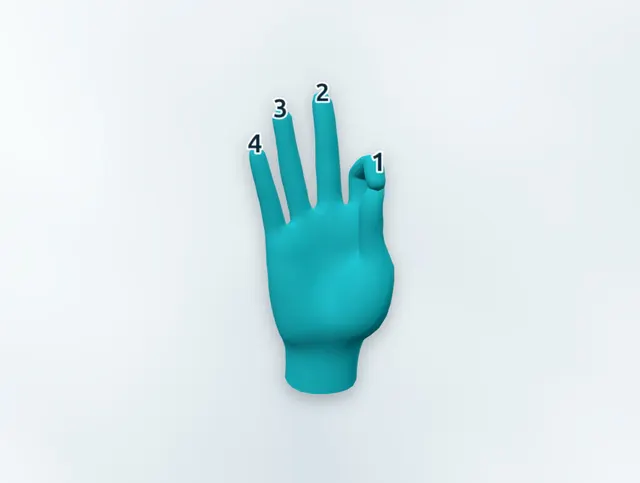
Finger Anchors
Slow, paced finger tapping that follows a gentle beat to steady your breath and lower arousal.
Type: grounding
Try 3 exercises for free right now.
Supporting a team?
Zen+ Health helps employers reduce avoidable absence and support wellbeing, privately, with anonymised insight only.
Zen+ Health for Business →What is the Finger Anchors Technique?
Finger Anchors is a patterned finger-tapping exercise for grounding yourself when anxiety, panic, or a racing mind takes hold. You tap the tip of your thumb to each fingertip in a deliberate, non-automatic sequence, following a steady beat. Unlike drumming your fingers absent-mindedly, the patterns here are designed so your movement cannot slip onto autopilot - and that is precisely the point.
The exercise comes in three variations of increasing difficulty:
- Steady - slow, sequential tapping (thumb to index, middle, ring, little finger) in time with a gentle beat, to calm a rising sense of arousal.
- Skip - a “skip-step” pattern where one finger is deliberately bypassed each round, and it is never the same finger twice running, so your natural rhythm keeps getting broken and looping thoughts are interrupted.
- Shuffle - the four fingers tap in a fresh random order every cycle, so you can never anticipate the next one, loading your working memory heavily enough to override an intense panic spike.
Like other grounding methods (such as the 5‑4‑3‑2‑1 senses exercise), Finger Anchors requires no special equipment or meditation skill - just your hands. It can be done discreetly at a desk, in a waiting room, or under a meeting table. The whole exercise takes only a couple of minutes, and because it gives your mind a concrete physical puzzle to solve, it is especially useful in moments when anxious thoughts are spiralling and it is hard to “just relax.”
Why tapping? Rhythmic, structured movement gives your attention something specific and physical to hold onto. When that movement is made slightly awkward on purpose - a skipped finger, an order you cannot predict - it demands active, moment-to-moment control, leaving far less mental bandwidth for worry.
How It Works (Neuro-Cognitive Mechanisms)
Finger Anchors draws on three mechanisms that, together, help pull attention away from the anxiety loop and back into the body.
1. Breaking motor automation (working-memory taxation)
When you tap your fingers in a simple, familiar order (1‑2‑3‑4), your brain quickly hands the movement over to muscle memory - low-level, automated sensorimotor processing. That frees your conscious mind to keep spiralling through anxious thoughts. Introducing a disruption - forcing yourself to skip a finger, or to follow an order that changes every cycle - demands higher-order executive control and active working memory to suppress your habitual motor pattern. Research on finger tapping shows that even low-level sensorimotor timing draws on attentional and predictive brain systems (Hove et al., 2017). Because working memory has a strictly limited capacity, occupying it with a self-monitored physical puzzle starves the anxiety loop of the cognitive resources it needs to persist.
2. Somatosensory attention shifts
Anxiety over-activates internal, self-referential processing, keeping you trapped in abstract worry. Deliberately focusing on distinct tactile sensations - the exact pressure of a finger pad pressing into your thumb - reallocates your brain’s attentional resources toward external, present-moment sensory input. Experimental work on somatosensory attention shows that briefly directing awareness to bodily touch measurably changes how the brain processes tactile signals and reduces attention to distressing internal experience (Bokk & Forster, 2022). Anchoring to intense, localised touch acts as a shield against internal alarm.
3. Neural stabilisation through ritual
Structured, predictable, chunked action sequences are a behavioural defence against chaos and uncertainty. Cognitive neuroscience shows that performing precise behavioural sequences - “performance rituals” - under stress buffers the brain against uncertainty and downregulates the neural alarm response associated with failure and threat (Hobson et al., 2017). The fixed, repeatable structure of a tapping pattern provides exactly this kind of stabilising ritual.
Taken together, Finger Anchors works on both the psychological level (crowding out anxious thoughts with a demanding physical task) and the physiological level (a slow, paced version encourages slower breathing and a calmer arousal state, much like a breathing exercise).
The Three Variations
Practitioners vary finger-tapping grounding by how much cognitive distraction a person needs. Finger Anchors offers three tiers, each loading working memory a little harder than the last:
| Tier | Variation | How it works | Best for |
|---|---|---|---|
| Steady | Paced audiomotor sync | Match each deliberate tap to a slow, steady beat, tapping thumb to each fingertip in order. | Lowering heart rate and soothing physiological arousal. |
| Skip | Skip step | Tap three of the four fingers in order, bypassing one - a different one each round - to break the physical rhythm. | Interrupting rapid, looping thoughts. |
| Shuffle | Randomised order | Tap all four fingers, but in a fresh random order each cycle, so the sequence can never be anticipated or rehearsed. | Maximising working-memory load during intense panic spikes. |
On pacing. Spontaneous, comfortable tapping tends to sit around 2 Hz - roughly two taps per second, or an inter-tap interval near 500-600 ms (a “resonance” tempo seen across walking, clapping and tapping). Grounding aims to downshift arousal, so Steady deliberately uses a slower-than-spontaneous beat (about one tap per second) to encourage a calmer state, in the same spirit as slow-paced breathing. Skip and Shuffle stay at a moderate tempo - fast enough that suppressing the habitual sequence requires genuine effort and attention, but slow enough to stay controllable. A session of a couple of minutes is enough to shift attention and settle arousal; there is no benefit to rushing.
Scientific Benefits
As with most grounding techniques, patterned finger tapping has not been isolated in large randomised trials - it is used as a component of coping and therapy rather than a standalone treatment. Its rationale rests on converging evidence from motor-timing research, attention research, and studies of ritual under stress.
- Occupying the anxious mind. Finger-tapping tasks reliably engage attentional and predictive brain systems even at low levels of the movement (Hove et al., 2017). A pattern engineered to resist automation keeps those systems occupied, leaving less capacity for rumination.
- Shifting attention off internal distress. Brief, deliberate attention to touch changes somatosensory processing and pulls awareness toward the present body rather than internal worry (Bokk & Forster, 2022) - the same attentional shift that makes sensory grounding effective.
- Calming the threat response. Ritualised, precise action sequences reduce the neural alarm response under stress and uncertainty (Hobson et al., 2017), which may help explain why a fixed tapping routine feels stabilising in the moment.
- Present-moment focus reduces rumination. More broadly, exercises that pull attention into the present moment are associated with reduced rumination and worry - a well-established benefit of mindfulness-style practices that grounding techniques share.
The evidence base here is largely mechanistic and indirect. That is a reasonable footing for a low-risk, high-accessibility self-help tool: there is nothing physically risky about tapping your fingers, and the underlying attention and motor-control principles are well supported.
How to Do the Finger Anchors Exercise
All three tiers use one hand - whichever is comfortable - and can be done seated or standing. Rest your hand on your lap, a desk, or your knee. The app shows which finger to tap next and paces you with a gentle beat and a light vibration; follow along at that pace rather than racing ahead.
Steady (paced sequence) 1. Rest one hand comfortably. Take one slow breath. 2. On each beat, touch your thumb to the next fingertip in order: index, middle, ring, little finger. 3. When you reach the little finger, start again at the index finger. Keep the beat slow and even. 4. Focus on the exact feeling of each fingertip meeting your thumb - the pressure, the warmth, the contact.
Skip (skip a finger) 1. This time one finger is skipped on each round - so you might tap index, ring, little finger (bypassing the middle), and on the next round index, middle, little finger (bypassing the ring). 2. Which finger gets skipped changes every round, so you can’t settle into it. Watch the guide for the next finger rather than anticipating it - that effort is the exercise working. 3. If you lose the pattern, simply pick it back up on the next beat. Getting it slightly “wrong” and correcting is completely fine - it still occupies the mind.
Shuffle (random order) 1. Same hand, same four fingers - but this time the order changes every cycle. The app highlights the next finger and gives it a number; there is no pattern to learn. 2. On each beat, move your thumb to whichever finger is highlighted. Because you can’t anticipate it, you have to stay with the guide rather than run ahead of it. 3. This is deliberately demanding. Go slowly and don’t worry about perfection. The mental effort of watching for each fresh finger is exactly what pulls your attention away from panic.
As you tap, really engage with each touch for a moment. Notice the specific sensation at each fingertip. If your mind drifts back to anxious thoughts, gently return your attention to the next tap - just as you would in meditation.
When to Use This Technique
Finger Anchors is a flexible in-the-moment coping tool. Because it is quiet and needs only your hands, it works well in situations where a more visible exercise would feel awkward.
Best times to use it during a workday
Anticipatory anxiety - the dread before a stressful event - often peaks before the event itself. There are two especially useful windows:
- The morning-of window (about 60-120 minutes before). As anticipatory anxiety begins to build ahead of a big meeting, presentation, or difficult conversation, a slightly longer, calming session lowers your baseline arousal so the peak, when it arrives, is lower. The Steady tier fits here.
- The transition window (about 10-20 minutes before). As you walk to the meeting room, join the video call, or wait to be called in, anxiety accelerates. A quick tapping session anchors you during that transition. Skip works well here to cut through pre-event thought spirals.
Other good moments:
- Caught in a thought spiral. When the same anxious thought keeps looping, the Skip pattern gives your mind a competing task.
- Acute panic spikes. When arousal is very high and lighter techniques aren’t landing, the demanding Shuffle pattern can help override the panic.
- Restlessness or overwhelm. A minute of paced tapping can act as a mental reset between tasks or after a stressful call.
You can also practise Finger Anchors when calm, so the patterns feel familiar when you actually need them under stress.
Research & Evidence
The rationale for Finger Anchors draws together three strands of research:
Motor timing and attention. Hove, Gravel, Spencer and Valera (2017) studied finger tapping and pre-attentive sensorimotor timing, showing that even automatic-seeming tapping recruits attentional and predictive timing systems in the brain. Disrupting the habitual pattern forces those systems into conscious, effortful control - the “working-memory taxation” that crowds out anxious thought. Separately, motor-timing research on spontaneous tapping tempo (around 2 Hz, or ~500-600 ms between taps) informs the exercise’s pacing: a slower-than-spontaneous beat is used to encourage a calmer state.
Somatosensory attention. Bokk and Forster (2022) found that a short period of directing attention to bodily touch measurably alters somatosensory processing. This supports the idea that deliberately anchoring attention to fingertip sensation shifts resources away from internal, worry-focused processing and toward the present moment.
Ritual under stress. Hobson, Bonk and Inzlicht (2017) showed that performing a structured ritual reduces the brain’s neural response to performance failure, buffering against the uncertainty and threat signals that drive anxiety. A fixed, repeatable tapping sequence provides exactly this kind of stabilising structure.
As with sensory grounding generally, this is an area where mechanistic and indirect evidence, clinical use, and neuroscience converge rather than one where a single large trial has tested the exact exercise. It is best understood as an accessible, low-risk coping skill grounded in well-supported principles of attention and motor control.
Citations
Hove, M. J., Gravel, N., Spencer, R. M. C., & Valera, E. M. (2017). Finger tapping and pre-attentive sensorimotor timing in adults with ADHD. Experimental Brain Research, 235, 3663-3672. https://doi.org/10.1007/s00221-017-5089-y
Bokk, O., & Forster, B. (2022). The Effect of a Short Mindfulness Meditation on Somatosensory Attention. Mindfulness, 13, 2022-2030. https://doi.org/10.1007/s12671-022-01938-z
Hobson, N. M., Bonk, D., & Inzlicht, M. (2017). Rituals decrease the neural response to performance failure. PeerJ, 5, e3363. https://doi.org/10.7717/peerj.3363
Additional Resources
Healthline - “30 Grounding Techniques to Quiet Distressing Thoughts” - A broad overview of sensory, cognitive, and physical grounding methods, including tactile techniques. https://www.healthline.com/health/grounding-techniques
Psychology Tools - Grounding Techniques - A therapy resource explaining grounding and structured prompts for practising it. https://www.psychologytools.com/resource/grounding-techniques/
Safety & Precautions
Finger Anchors is very safe - you are simply tapping your fingers and directing your attention - but a few notes help you get the most from it:
- It’s a coping skill, not a cure. Finger Anchors helps you get through moments of high anxiety or panic. It doesn’t replace professional treatment for an anxiety disorder, PTSD, or panic disorder. Use it as one tool among many, and seek professional help for underlying issues.
- You don’t have to do it perfectly. Skipping a beat, losing the pattern, or getting the “wrong” finger is completely fine - the effort of noticing and correcting is part of what occupies the mind. There is no way to fail this exercise.
- Start gentle. If you’re new to it or very activated, begin with the Steady tier. Move to Skip or Shuffle only if you want a more demanding distraction. The harder patterns are meant to be effortful, not frustrating.
- Some anxiety may remain. The aim is to help you function through the moment and keep a spike from escalating - not necessarily to feel zero anxiety. That’s a success.
- If symptoms persist or worsen. If your panic or distress keeps intensifying despite grounding, reach out for support. In a crisis, use additional coping strategies or contact a mental health professional.
- Physical comfort. If you have hand or joint pain, tap lightly and stop if it’s uncomfortable; you can slow the pace, or rest and switch to your other hand.
Summary
Finger Anchors is a quick, discreet, and effective way to steady yourself when anxiety rises. By tapping your fingers in deliberate patterns that resist autopilot - a slow paced beat, a skipped finger, or an order that changes every cycle - you give your mind a concrete physical task that crowds out worry, anchor your attention in the sensation of touch, and lean on the stabilising structure of a repeatable ritual.
Reach for the Steady tier to lower your arousal ahead of a stressful event, Skip to break a thought spiral, and Shuffle when a panic spike needs a demanding anchor. Practise the patterns when you’re calm so they’re ready when you need them - and remember there’s no wrong way to tap.
This information is intended for educational purposes and to aid in self-help for anxiety. It is not a substitute for professional mental health treatment. If you experience frequent severe anxiety or panic attacks, consider reaching out to a mental health professional for additional support.
Explore more
- All mindfulness & breathing exercises: the full research-backed library.
- ZenScore: your private daily wellbeing signal.
- Timeline: proactive micro-resets scheduled around your day.
- Download the app for iOS & Android.

